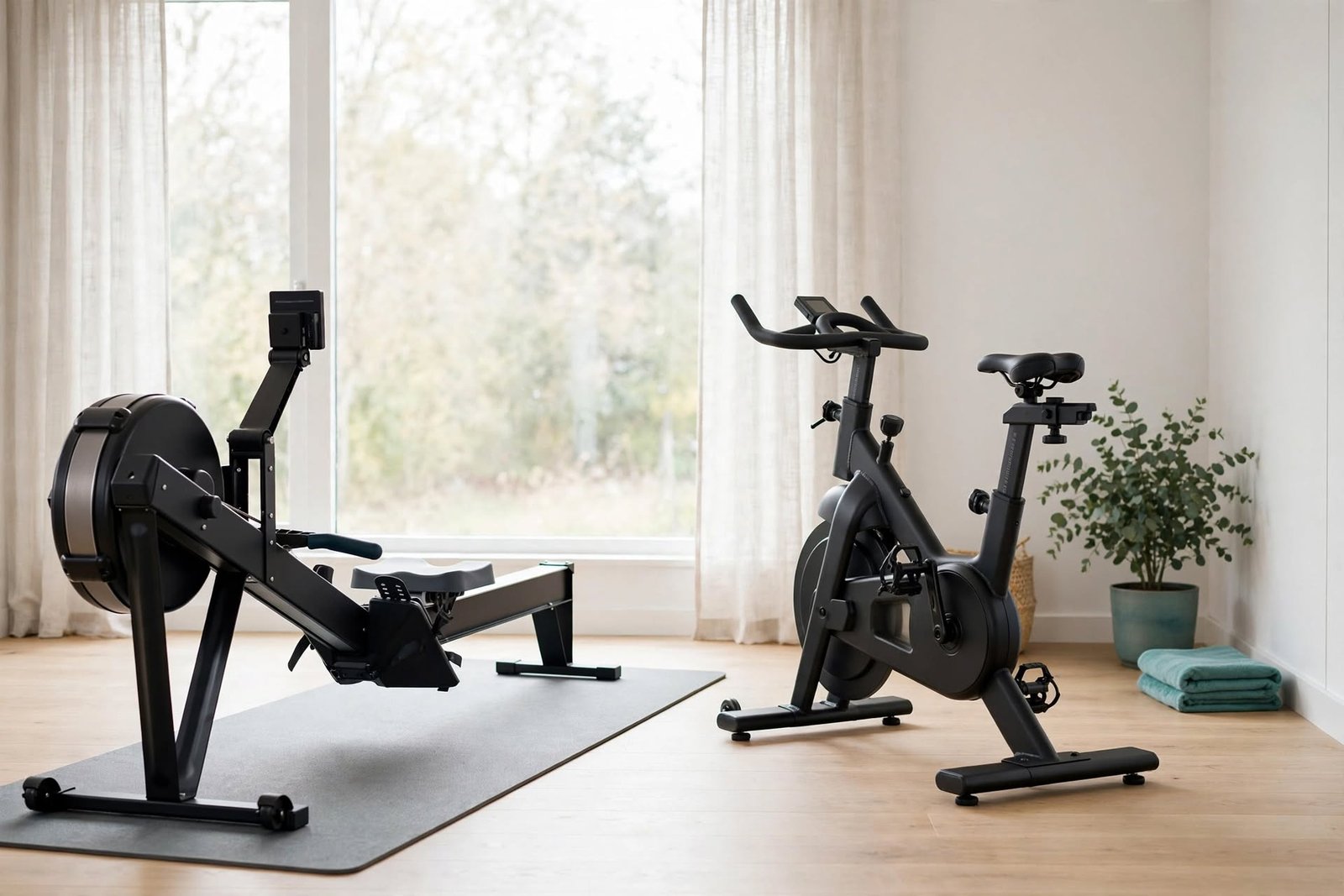
If you want one cardio machine at home, a rowing machine and an exercise bike are two of the most popular choices. Both are low impact, both can deliver a hard workout, and both fit in most homes. But brand blogs often make bold claims, such as “rowing burns 50% more calories” or “rowing works 86% of your muscles,” that are hard to verify.
This guide compares the two using the official energy-cost data researchers use, then looks at muscles worked, joint comfort, learning curve, space, and noise. By the end, you’ll know which machine fits your goals, your body, and your home.
The Short Answer
- For calories, effort matters more than the machine. At similar power outputs, research-based estimates for rowing and stationary cycling are fairly close. Whichever you’ll push harder on, and use more often, will burn more.
- Choose a rowing machine if you want more upper-body and back involvement, enjoy rhythmic full-body movement, and have the floor length for it.
- Choose an exercise bike if you want the easiest learning curve, a gentler option for your back, the ability to read or watch TV comfortably, or a smaller footprint.
- Choose a recumbent bike if you’re older, deconditioned, or have back or balance concerns.
Rowing Machine vs Exercise Bike at a Glance
| Factor | Rowing Machine | Exercise Bike |
|---|---|---|
| Main muscles | Legs, glutes, back, core, arms, shoulders | Mainly legs and glutes |
| Calories | Similar to cycling at similar effort | Similar to rowing at similar effort |
| Impact on joints | Low impact | Low impact; recumbent bikes are especially gentle |
| Lower back demand | Higher; technique matters | Lower, especially on recumbent bikes |
| Learning curve | Moderate; technique takes practice | Very easy |
| Multitasking (TV, reading) | Harder | Easy |
| Footprint | Long and narrow | Compact |
| Noise | Varies; air rowers are louder | Usually quiet, especially magnetic bikes |
Calories: What the Research Data Actually Shows
Many comparison articles claim rowing burns far more calories than cycling. The most reliable way to compare is the 2024 Adult Compendium of Physical Activities, the research database scientists use to estimate energy cost. It expresses effort in METs (metabolic equivalents), where higher numbers mean more energy burned.
Here’s how the two machines compare at similar outputs (Compendium: Conditioning Exercise; Compendium: Bicycling):
| Activity | MET value |
|---|---|
| Rowing, under 100 watts, moderate effort | 5.0 |
| Stationary cycling, 90–100 watts | 6.0 |
| Stationary cycling, general | 6.8 |
| Rowing, general, vigorous effort | 7.3 |
| Rowing, 100–149 watts | 7.5 |
| Stationary cycling, 126–150 watts | 8.0 |
| Stationary cycling, spin class | 9.0 |
| Stationary cycling, 151–199 watts | 10.3 |
| Rowing, 150–199 watts | 11.0 |
What this means: At similar power outputs, rowing and cycling have broadly similar energy costs. Rowing is slightly higher in some ranges, cycling in others. There’s no evidence that one machine burns dramatically more calories when you work equally hard.
Example: 30 minutes for a 70 kg (154 lb) person
Using the standard MET formula (calories per minute ≈ MET × 3.5 × body weight in kg ÷ 200):
| Workout | Approximate calories in 30 minutes |
|---|---|
| Moderate rowing (MET 5.0) | about 184 kcal |
| Stationary cycling, general (MET 6.8) | about 250 kcal |
| Vigorous rowing, general (MET 7.3) | about 268 kcal |
| Spin class (MET 9.0) | about 331 kcal |
These are estimates. Actual calories vary with your fitness, body size, and how hard you work. The takeaway: intensity and consistency matter far more than which machine you choose.
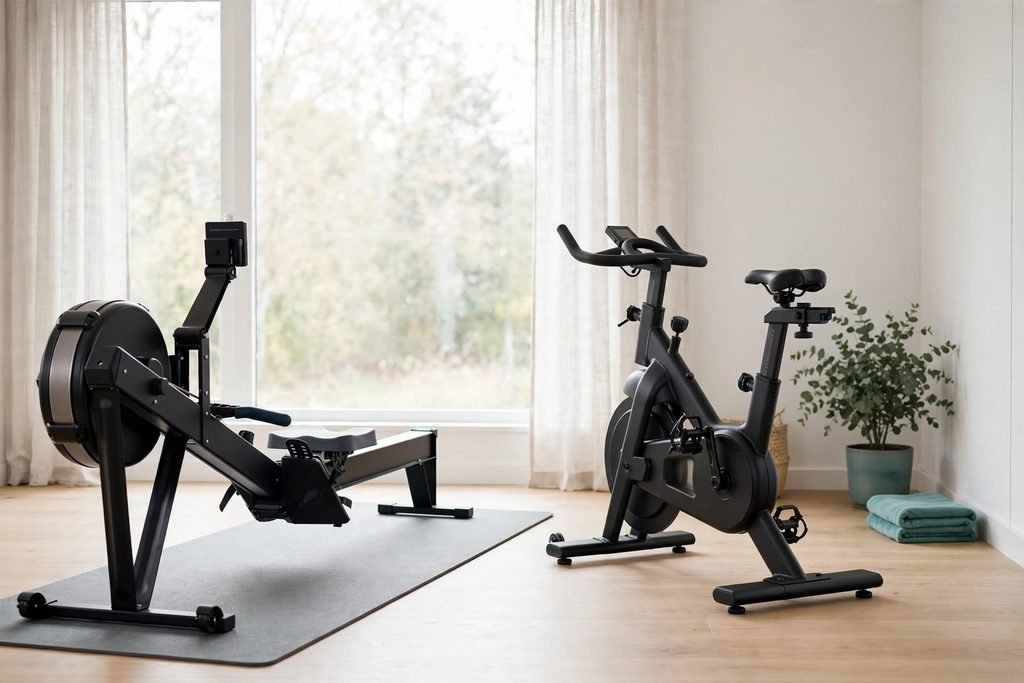
Muscles Worked
Rowing machine: Each stroke starts with a leg drive, then your hips swing back, and finally your arms pull the handle to your body. This involves your legs, glutes, back, core, shoulders, and arms. A trainer quoted by Livestrong noted that no cardio machine comes close to a rower for developing the back (Livestrong).
Exercise bike: Pedaling works mainly the quadriceps, hamstrings, glutes, and calves. Your core works to stabilize you, especially on upright and spin bikes, but your upper body does little.
Important caveat: Neither machine replaces strength training. Both build cardiovascular fitness and muscular endurance, but for muscle strength you still need resistance exercise. See our guide to resistance bands vs dumbbells.
Joint Comfort and Back Health
Both machines are low impact compared with running.
Exercise bikes are generally the gentler choice:
- Recumbent bikes support your back and are often recommended for older adults and people who are deconditioned. A fitness director quoted by Livestrong described them as a first choice for these groups.
- Upright bikes are similar to riding a regular bicycle.
- Spin bikes allow a more aggressive, athletic position.
Rowing machines place more demand on your lower back, especially with poor technique, such as rounding your spine or pulling mainly with your arms. If you have a history of back pain, start with light resistance and focus on form, or consider a bike first. If you have knee or hip issues, the deep knee bend at the start of each rowing stroke may be uncomfortable.
If you have an existing injury or medical condition, check with a doctor or physical therapist before starting a new cardio routine.
Learning Curve
Exercise bike: Almost no learning required. Adjust the seat, start pedaling, and change the resistance.
Rowing machine: Good technique takes practice. The basic sequence is:
- Drive: push with your legs first.
- Swing: lean back slightly from the hips.
- Pull: draw the handle toward your lower ribs.
- Recovery: reverse the order: arms forward, lean forward, then bend your knees.
Common beginner mistakes include pulling with the arms too early, rounding the back, and rushing the recovery. A few short sessions focused on form make a big difference.
Space, Noise, and Convenience
| Factor | Rowing Machine | Exercise Bike |
|---|---|---|
| Space | Long; one rower brand estimates about 9 × 4 ft of space | Compact; about 7–10 sq ft (Aviron) |
| Storage | Many models fold or stand upright | Usually stays in place; some fold |
| Noise | Air rowers are louder; magnetic and water rowers vary | Magnetic bikes are typically quiet |
| Watching TV or reading | Harder because of the moving body position | Easy |
| Apartment-friendly | Depends on noise and floor length | Often easier |
Which Should You Choose?
A rowing machine is a good fit if you:
- Want more upper-body and back involvement in your cardio
- Enjoy rhythmic, full-body movement
- Have a long enough space, or a model that stands upright for storage
- Are willing to spend a few sessions learning technique
An exercise bike is a good fit if you:
- Want the simplest machine to start using right away
- Have back, knee, or balance concerns (consider a recumbent bike)
- Want to watch TV, read, or take calls while working out
- Have limited floor space or need quiet operation
Still unsure? Think about which one you’ll actually enjoy using several times a week. Consistency beats any small difference between machines.
For specific models, see our guides to the top rowing machines for home workouts and top exercise bikes for cardio, or browse Fittnexa’s rowing machines and exercise bikes categories.
What to Look For When Buying
Rowing machine:
- Resistance type: air (smooth but louder), magnetic (quiet), or water (smooth with a natural feel)
- Rail length, especially if you’re tall
- Seat comfort and height, especially if getting low to the floor is difficult
- Folding or upright storage if space is tight
- Monitor showing time, distance, and power output
Exercise bike:
- Type: recumbent (most support), upright, or spin (most athletic)
- Adjustability of seat and handlebars for your height
- Resistance system and smoothness
- Stability and weight capacity
- Monitor or app connectivity if you want structured workouts
Common Mistakes to Avoid
- Choosing based on calorie claims alone. At similar effort, the difference is small.
- Rowing with your arms instead of your legs. Most of the power should come from your legs.
- Setting the bike seat too low or too high. You should have a slight bend in your knee at the bottom of each pedal stroke.
- Starting too hard. Build up gradually, especially with rowing.
- Skipping strength training. Cardio machines don’t replace resistance exercise.
Frequently Asked Questions
Which burns more calories, rowing or cycling?
At similar power outputs, research-based estimates are fairly close. The machine you’ll work harder on and use more consistently will burn more calories.
Is rowing bad for your back?
Not inherently, but it places more demand on your lower back than cycling, especially with poor technique. Start with light resistance and focus on form. If you have back pain, consider a recumbent bike or talk to a professional first.
Which is better for weight loss?
Weight loss depends mainly on your overall diet and total activity. Both machines can help. Choose the one you’ll use most consistently.
Can I build muscle with a rowing machine or exercise bike?
Both can improve muscular endurance, and beginners may see some strength gains. For meaningful muscle growth, add resistance training with weights or bands.
Which is better for bad knees?
Both are low impact. Many people with knee issues find a recumbent or upright bike more comfortable, since rowing involves deeper knee bending at the start of each stroke. Get personalized advice from a physical therapist if you have knee pain.
How long should I work out on a rower or bike?
U.S. guidelines recommend at least 150 minutes of moderate-intensity activity per week. Short, regular sessions of 20–30 minutes on either machine can help you get there.
Conclusion
Rowing machines and exercise bikes are both excellent low-impact cardio options, and at similar effort they burn broadly similar calories according to research-based estimates. Rowing involves more of your upper body and back but requires good technique and more space. Exercise bikes are easier to learn, gentler on the back, quieter, and better for multitasking.
The best choice is the one that fits your body, your home, and your preferences, because the machine you’ll use consistently is the one that delivers results.
Sources
- 2024 Adult Compendium of Physical Activities: Conditioning Exercise and Bicycling.
- Livestrong. Rowing Machines vs. Exercise Bikes.
- Aviron. Rowing Machine vs Exercise Bike.
Health information disclaimer: This article is for general educational purposes and is not medical advice. Consult a qualified healthcare professional before starting a new exercise program, especially if you have back, knee, or heart conditions.