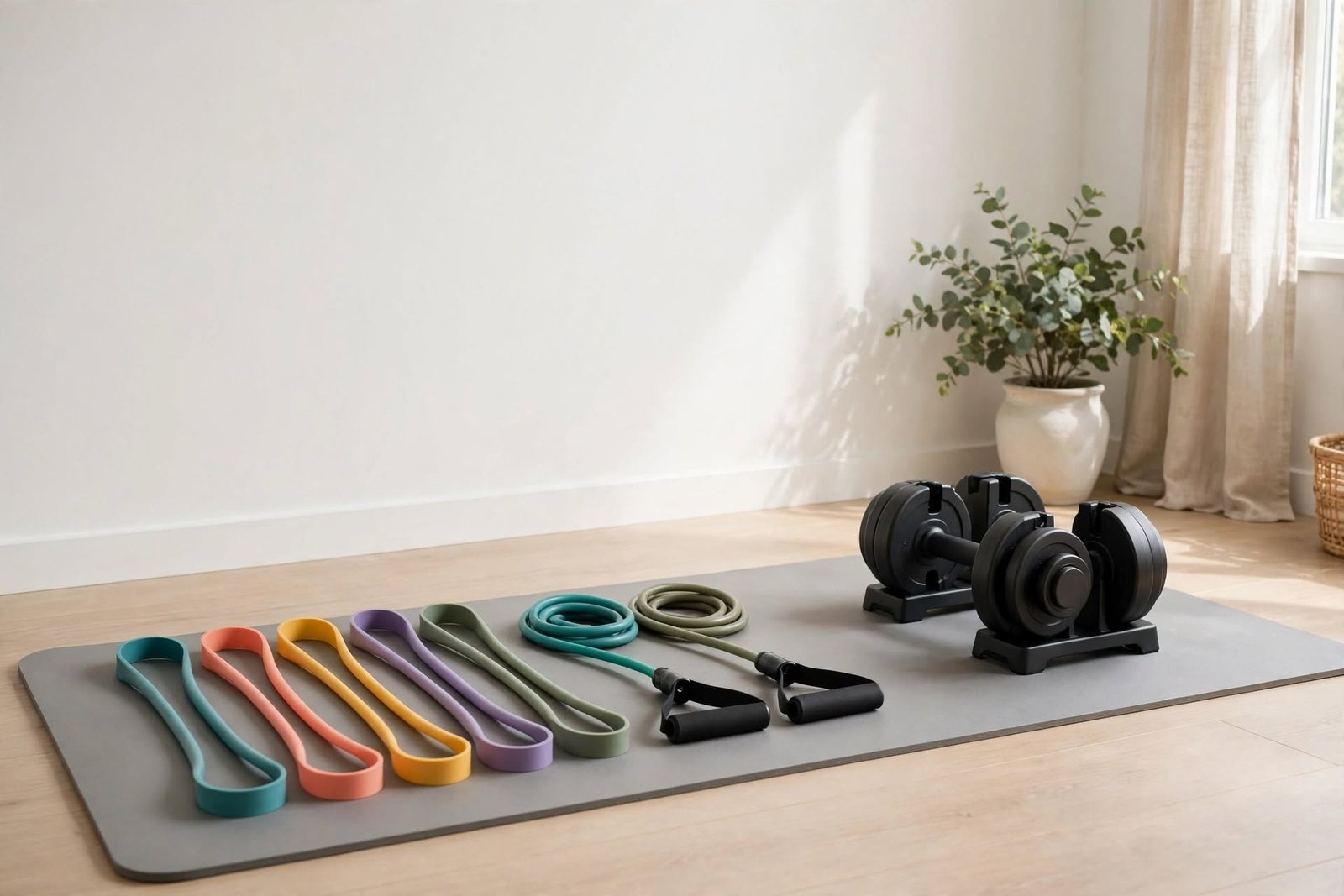
If you’re building a home workout setup, one of the first decisions is whether to spend your money on a set of resistance bands or a pair of dumbbells. Bands are cheap, light, and fit in a drawer. Dumbbells are precise, familiar, and feel like “real” lifting. Fitness forums are full of strong opinions on both sides.
This guide covers what the research says about strength gains, how the two tools load your muscles differently, which exercises suit each one, how to keep progressing, and the safety issues people often overlook. By the end, you’ll know which to buy first, or whether a combination makes more sense.
The Quick Answer
For general strength, both work. Controlled studies comparing elastic resistance with free weights and machines have found similar strength gains.
Choose resistance bands first if you’re a beginner, short on space or budget, travel often, or are easing back into exercise.
Choose dumbbells first if you want precise, measurable progression, plan to lift heavier over time, or care most about lower-body strength and muscle size.
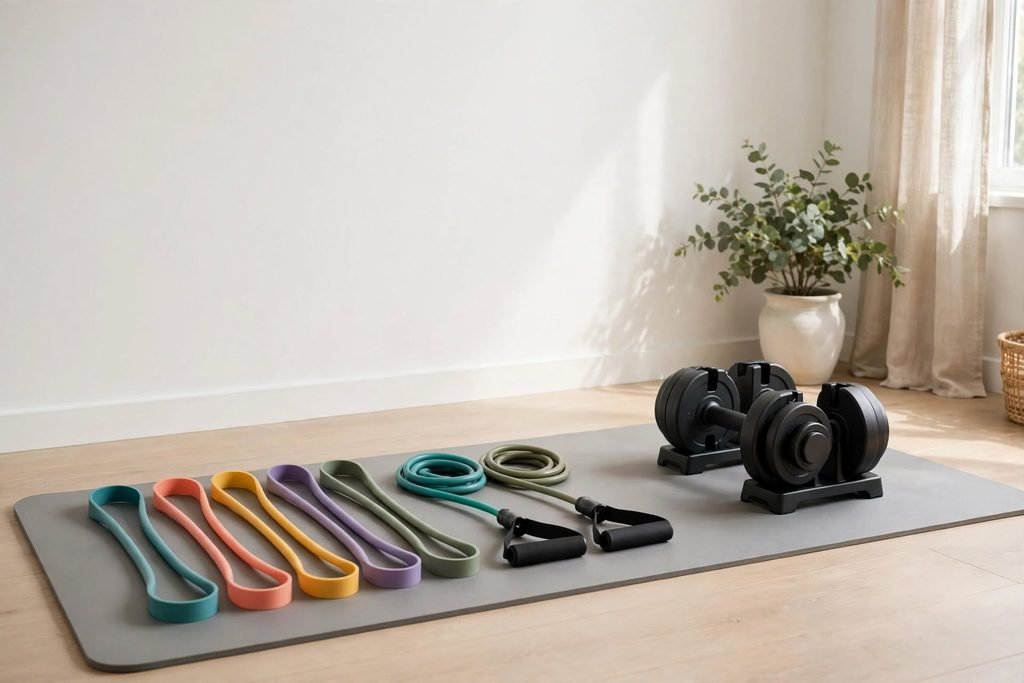
The best long-term setup for most people is both: adjustable dumbbells for the main lifts, plus bands for warm-ups, pulling exercises, and travel.
Resistance Bands vs Dumbbells at a Glance
| Factor | Resistance Bands | Dumbbells |
|---|---|---|
| Strength gains (research) | Similar to free weights in controlled trials | Similar to bands in controlled trials |
| How resistance works | Increases as the band stretches | Constant weight; difficulty depends on body position |
| Load precision | Approximate; varies with stretch and anchor point | Exact and repeatable |
| Progression | Thicker bands, stacking, anchor changes, reps, tempo | Add weight in fixed increments |
| Heavy lower-body loading | Harder to achieve | Easier |
| Cost | Low | Moderate to high (especially adjustable sets) |
| Space and portability | Excellent | Limited |
| Lifespan | Wear out over time; inspect regularly | Very long |
| Main safety risk | Snapping or detaching under tension | Dropping, or loose plates on adjustable models |
What the Research Says
The most direct evidence comes from a 2019 systematic review and meta-analysis in SAGE Open Medicine (Lopes et al., 2019). It included only randomized trials comparing training with elastic devices such as tubes and Thera-Bands against weight machines and dumbbells, with muscular strength as the outcome.
Across the eight included studies, neither method came out ahead for upper-body or lower-body strength. The authors concluded that elastic resistance training can produce strength gains similar to conventional training across different populations and training programs.
How to read this fairly:
- Eight studies is a small evidence base. The trials were relatively short and often involved untrained, middle-aged, or older adults, not experienced lifters.
- The outcome was strength, not muscle size. Evidence directly comparing muscle growth is more limited.
- Matching the “load” is difficult. Band resistance changes through each rep, so it’s hard to compare a band workout exactly with a dumbbell workout.
The practical takeaway: for most beginners and general-fitness goals, the tool matters less than consistency, effort, and gradually increasing the challenge. The differences that remain come down to mechanics, progression, and practicality.
How the Resistance Feels Different
This is the real difference between the two tools.
Dumbbells use gravity. The weight never changes, but how hard an exercise feels depends on your body position. A dumbbell lateral raise is easy at the bottom and hardest when your arm is parallel to the floor. Resistance always pulls straight down.
Bands use stretch. The further you stretch a band, the more resistance it gives. Exercises tend to be easiest at the start and hardest at the end. Because the direction of pull depends on where you anchor the band, you can load movements gravity can’t, such as horizontal pulls and rotations.
What this means for exercise choice:
| Better with bands | Better with dumbbells | Both work well |
|---|---|---|
| Face pulls and band pull-aparts | Goblet squats, split squats, Romanian deadlifts | Rows |
| Standing chest press and rows from a door anchor | Lateral raises and overhead presses | Biceps curls |
| Anti-rotation (Pallof) presses | Floor or bench presses | Triceps work |
| Hip abduction and glute activation with mini loops | Farmer’s carries | Glute bridges |
| Assisted pull-ups | Loaded lunges and step-ups |
A key limitation of bands is heavy leg training. Strong legs can quickly outgrow even thick bands for squats and hinges, and setting up heavy bands safely is awkward. This is where dumbbells, especially heavier adjustable ones, have a clear edge.
Progressive Overload: How to Keep Getting Stronger
Muscles adapt to a challenge, so the challenge has to increase over time. Both tools can do this, but in different ways.
With dumbbells, progression is simple and measurable. When you can complete all your reps with good form, go up to the next weight. Adjustable dumbbells make this easier. Some sets in our adjustable dumbbell guide advertise 5 lb increments. The downside is that big jumps can be too much on small-muscle exercises like lateral raises.
With bands, you have more options but less precision:
- Move up a band. Switch to the next resistance level.
- Stack bands. Use two bands together for more tension.
- Change the stretch. Step farther from the anchor or shorten the band so it starts with more tension.
- Add reps or sets before switching bands.
- Slow the tempo, especially the lowering phase, or add a pause at full stretch.
Tip: Keep a simple log for band training: which band, your foot position or anchor distance, and reps. Without it, “same band” can mean very different workloads from one week to the next.
Cost, Space, and Durability
Cost. Bands are the clear budget winner. A full set usually costs less than one pair of light dumbbells. Adjustable dumbbells cost more upfront, but they replace a full rack of fixed weights. At the time of writing, the adjustable sets in our guide were listed between roughly $110 and $425, depending on weight range and mechanism.
Space. A full band set fits in a drawer or a travel bag. Adjustable dumbbells need a small floor area for their stands. Fixed dumbbell pairs take up the most room.
Durability. Dumbbells can last for decades. Bands are consumables: latex and rubber degrade with use, sunlight, heat, and friction against rough surfaces or sharp edges. Expect to replace bands periodically, and treat any visible damage as a reason to stop using that band.
Safety: The Part Most Comparisons Skip
Both tools are safe when used properly, but their risks are different.
Resistance band safety
A band under tension stores energy. If it snaps or comes loose, it can hit you hard. This isn’t theoretical. In 2026, the U.S. Consumer Product Safety Commission announced a recall of HomeProGym’s 60 lb and 70 lb bands after five reports of bands forcefully separating from their handles (CPSC). An earlier recall of Perfect Fitness bands listed reported injuries to the back, hand, and eye (CPSC). SPRI ultra-heavy bands were also recalled after the rubber separated from the handle and struck users (CPSC).
To use bands more safely:
- Inspect before every session. Look for nicks, cracks, thinning, stickiness, or fraying at handle connections. Retire damaged bands.
- Anchor securely. Use a proper door anchor on the hinge side of a closed door, or a solid fixed object. Never anchor to anything that could move or has sharp edges.
- Don’t overstretch. Avoid stretching bands beyond the manufacturer’s stated limit.
- Keep your face out of the line of pull, especially on pulling exercises toward the head.
- Store bands away from sunlight, heat, and sharp objects.
- Check recalls at cpsc.gov if you own branded tube bands.
Dumbbell safety
- Check the lock on adjustable dumbbells every time you change weight, and return them to their stand fully seated.
- Don’t drop dumbbells onto bare floors or near feet. Use a mat.
- Choose a weight you can control. A rep you can’t lower slowly is too heavy.
- Store them low and away from children.
Which Should You Buy?
Start with resistance bands if you:
- Are new to strength training or returning after time off
- Have a tight budget or very little space
- Travel often or train in different places
- Want a tool for warm-ups, mobility work, and shoulder health
Start with dumbbells if you:
- Want clear, measurable progress week to week
- Prioritize leg strength and muscle size
- Already train regularly and have outgrown light resistance
- Prefer classic, familiar exercises like presses, rows, and squats
Get both if you:
- Train at home long term and want the most exercise variety
- Want dumbbells for main lifts and bands for pulling, rotation, and accessory work
You can browse current options in Fittnexa’s resistance bands and adjustable dumbbells categories.
A Simple Way to Combine Them
U.S. physical activity guidelines recommend muscle-strengthening activities on two or more days a week, working all major muscle groups: legs, hips, back, abdomen, chest, shoulders, and arms. A combined approach for two full-body sessions might look like this:
| Movement | Tool | Why |
|---|---|---|
| Goblet squat or split squat | Dumbbells | Easier to load the legs heavily |
| Romanian deadlift | Dumbbells | Hip hinge with measurable load |
| Floor or bench press | Dumbbells | Stable pressing |
| Anchored row or face pull | Bands | Horizontal pulling without a cable machine |
| Pallof press | Band | Core anti-rotation |
| Glute bridge with mini band | Band plus optional dumbbell | Hip and glute strength |
Choose a resistance that leaves you with a couple of good reps in reserve at the end of each set, and increase the challenge gradually.
Common Mistakes to Avoid
- Assuming a band’s label is precise. Ratings vary by brand and depend on how far you stretch the band. Track the band plus your setup instead.
- Using bands that are too light for too long. If you can do endless reps easily, you aren’t progressing.
- Jumping up dumbbell weight too quickly on small-muscle exercises like raises and triceps work.
- Ignoring the lowering phase. Bands snapping back or dumbbells dropping quickly wastes half of each rep.
- Skipping band inspections. Most band injuries come from worn or poorly anchored bands.
- Training only upper body. Legs and hips need work too, which is where dumbbells often help most.
Frequently Asked Questions
Can you build muscle with resistance bands alone?
Research shows bands can build strength comparable to free weights in controlled trials. Muscle growth has been studied less directly. Bands can provide a meaningful training stimulus when sets are taken close to fatigue, but it’s harder to load the lower body heavily with bands alone. Many people add dumbbells as they progress.
Are resistance bands better for your joints?
Bands are often used in rehabilitation because they allow light, controlled resistance and smooth movement. That doesn’t make them automatically safer for every joint issue. If you have pain or an injury, get guidance from a physical therapist or doctor.
What dumbbell weight range should a beginner buy?
It depends on your current strength and which exercises you plan to do. Many beginners start with an adjustable set that covers light weights for raises and arm work and heavier weights for squats and rows. Our adjustable dumbbell guide compares several weight ranges.
How often should I replace resistance bands?
There’s no universal timeline. It depends on material, how often you use them, and storage. Replace any band showing cracks, nicks, thinning, discoloration, stickiness, or a damaged connection point, and follow the manufacturer’s guidance.
Are loop bands and tube bands with handles the same?
No. Loop bands (large or mini) are continuous loops, often used for hips, legs, and assisted pull-ups. Tube bands have handles and clips, which make them feel more like cable machines. Tube bands have more connection points, so inspect the handles and clips carefully.
Conclusion
Resistance bands and dumbbells are both legitimate strength-training tools, and the available research shows similar strength gains with either. The better choice depends on your situation. Bands win on cost, space, portability, and variety of pulling angles. Dumbbells win on precision, durability, and heavy lower-body work.
If you can only buy one, choose bands for an affordable, space-saving start, or dumbbells if you want clear, measurable progress. Over time, combining both gives you the most complete home setup. Whichever you choose, train consistently, increase the challenge gradually, and inspect your equipment regularly.
Sources
- Lopes JSS et al. Effects of training with elastic resistance versus conventional resistance on muscular strength: a systematic review and meta-analysis. SAGE Open Medicine, 2019.
- U.S. Consumer Product Safety Commission: HomeProGym resistance band recall (2026), Perfect Fitness band recall, SPRI band recall.
- CDC Physical Activity Guidelines for Adults.
Health information disclaimer: This article is for general educational purposes and is not medical advice. If you have an injury, joint pain, a medical condition, or are new to exercise, consult a qualified healthcare professional before starting a strength-training program.