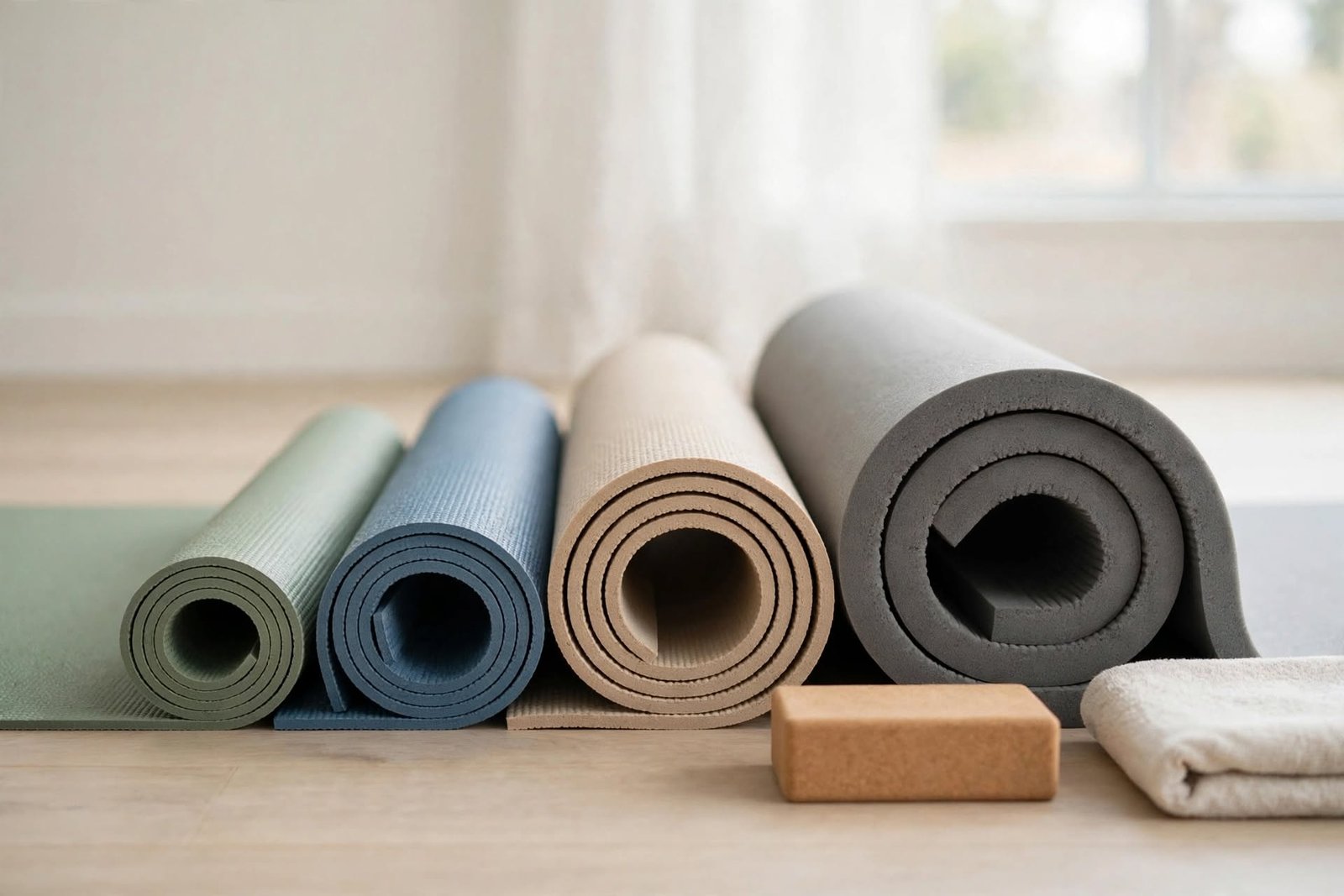
Yoga mats range from paper-thin travel mats to one-inch foam pads that look more like a mattress. Thicker sounds more comfortable, but a mat that’s too soft can make balance poses harder and your ankles work overtime. A mat that’s too thin can leave your knees and wrists sore.
This guide explains standard yoga mat thicknesses, which thickness suits different yoga styles and bodies, why density matters as much as thickness, and how the main materials (PVC, TPE, natural rubber, and cork) compare, including an important allergy warning.
The Short Answer
| Thickness | Best for |
|---|---|
| 1–2 mm (travel) | Travel, or layering over another mat or carpet |
| 3–4 mm (standard) | Most yoga styles, especially flowing styles like vinyasa |
| 5–6 mm (thick) | Sensitive knees and wrists, restorative and yin yoga, hard floors |
| 8 mm and above (extra thick) | Pilates, floor exercises, stretching, and home workouts; often too soft for standing balance poses |
If you’re a beginner and unsure: a 4–6 mm mat made of a dense material is a safe all-round choice.
Common Yoga Mat Thicknesses Explained
Thickness is often listed in millimeters or inches. Here’s how they compare:
| Inches | Approximate millimeters | Category |
|---|---|---|
| 1/16 in | about 1.5 mm | Travel |
| 1/8 in | about 3 mm | Standard |
| 1/4 in | about 6 mm | Thick |
| 1/2 in | about 13 mm | Extra-thick exercise mat |
| 1 in | about 25 mm | Extra-thick exercise mat |
Travel mats (1–2 mm)
Very light and foldable, often used on top of a studio mat or on carpet. Yoga Design Lab, a mat manufacturer, describes its 1.5 mm travel mats as best used as a topper over a studio mat or on a soft surface rather than as a beginner’s main mat (Yoga Design Lab).
Standard mats (3–4 mm)
A good balance of cushioning and stability. Industry guides commonly describe the standard range as about 3–4 mm (Yoga Design Lab). This range works well for vinyasa, power yoga, and Ashtanga, where you move quickly between poses.
Thick mats (5–6 mm)
A mat is generally considered “thick” at about 5–6 mm. These suit restorative yoga, yin yoga, people with sensitive knees or wrists, and practice on hard floors.
Extra-thick mats (8 mm and above)
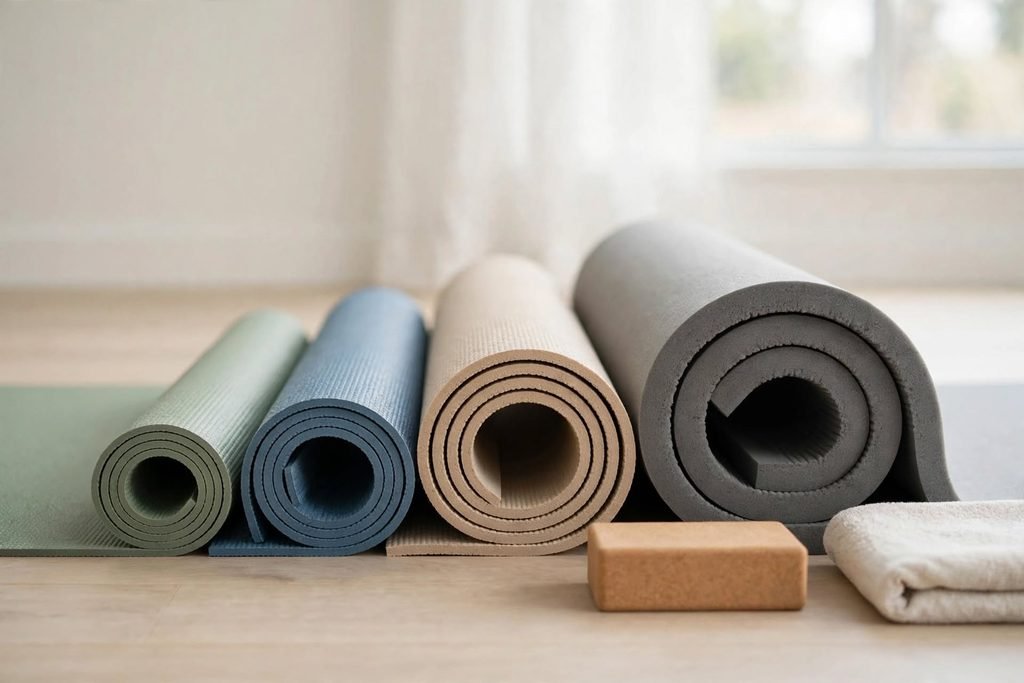
Once a mat goes beyond about 8 mm, it often moves out of yoga and into general fitness or Pilates territory (Yoga Design Lab). The common 1/2-inch and 1-inch foam mats are comfortable for floor exercises, stretching, and core work, but they can feel unstable in standing balance poses like Tree Pose.
Why Thicker Isn’t Always Better
On a very thick, soft mat, your feet and hands sink in, and your ankles have to work harder to stay balanced. Manufacturer guides note that a mat that’s too thick can make balance poses feel like standing on a sponge, and can even catch your toes during jumps in styles like Ashtanga.
Density matters as much as thickness. A thinner, dense mat can protect your joints better than a thick, low-density foam mat that compresses completely under your weight (Yoga Design Lab).
Quick test: Kneel on the mat. If your knees press through to the floor, the mat isn’t dense enough for kneeling poses, no matter how thick it is.
Matching Thickness to Your Practice
| Yoga style or use | Suggested thickness | Why |
|---|---|---|
| Vinyasa or power yoga | 3–5 mm | Stable base for flowing movement |
| Ashtanga | 3–4 mm | Firm surface for jump-throughs |
| Hatha | 4–6 mm | Balance of comfort and stability |
| Restorative or yin yoga | 5–6 mm | Extra comfort for long-held seated and lying poses |
| Hot yoga | 3–5 mm with good wet grip | Thick, porous mats can get heavy when soaked |
| Pilates and floor exercises | 6 mm and up | More cushioning for the spine and hips |
| Travel | 1–2 mm | Light and packable |
Matching Thickness to Your Body and Space
Sensitive knees, wrists, or back: Choose a dense 5–6 mm mat. You can also fold the mat or use a small cushion under your knees in kneeling poses, rather than buying a very soft, thick mat.
Practicing on carpet: A thinner mat is usually more stable. A thick mat on top of carpet creates a “double cushion” that can feel wobbly.
Practicing on hard floors (wood, tile, concrete): A 5–6 mm mat adds useful cushioning.
Commuting to class: Thicker mats are heavier to carry. Natural rubber mats are also heavier than PVC or TPE.
Taller practitioners: Look for longer mats (about 72 inches or more) so your head and feet stay on the mat in lying poses.
Yoga Mat Materials Compared
| Material | Grip | Cushioning feel | Weight | Notes |
|---|---|---|---|---|
| PVC | Good dry grip; can get slippery when sweaty | Dense, durable | Moderate | Traditional, affordable, long-lasting; petroleum-based and hard to recycle |
| TPE | Good dry grip; less wet grip | Soft and springy | Light | Affordable and lightweight; may wear out faster |
| Natural rubber | Excellent grip, including when damp | Dense and supportive | Heavy | Durable; contains latex; may have a rubber smell at first |
| Cork (usually with a rubber or TPE base) | Grip often improves when damp | Firm | Varies with base | Naturally antimicrobial surface; can crack if folded |
| Basic foam (NBR and similar) | Variable | Very soft | Light | Common in thick exercise mats; comfortable for floor work |
⚠️ Latex allergy warning
Natural rubber is made from latex, the sap of rubber trees, and contains latex proteins that can trigger allergic reactions. If you have a latex allergy, avoid natural rubber mats, and check cork mats, which often have a natural rubber base. Look for products labeled “latex-free” or choose TPE or PVC instead.
Hot Yoga and Sweaty Practices
Closed-cell materials like PVC and many TPE mats don’t absorb moisture, so they can become slippery when sweat pools on the surface. If you sweat heavily:
- Choose a mat with good wet grip, such as natural rubber or cork.
- Or use a microfiber yoga towel on top of a PVC or TPE mat for extra traction.
Browse Fittnexa’s yoga towels category for options.
Caring for Your Mat
- Wipe it down after use with a damp cloth and mild soap, then let it air dry fully.
- Keep it out of direct sunlight and hot cars, since heat and UV light can break down rubber, TPE, and cork.
- Roll, don’t fold, especially cork mats.
- Replace your mat when it starts flaking, losing grip, or no longer cushions your joints.
Choosing Your Mat: A Quick Checklist
- What will you mainly use it for? Flowing yoga, restorative yoga, Pilates, or general workouts?
- Where will you practice? Hard floor, carpet, or a studio?
- Do you have sensitive joints? If so, choose a dense 5–6 mm mat.
- Do you sweat a lot? Prioritize wet grip or add a towel.
- Do you have a latex allergy? Avoid natural rubber.
- Will you carry it often? Consider weight and thickness.
- How tall are you? Choose a long enough mat.
You can compare options in our guide to the top yoga mats for beginners and advanced yogis or browse Fittnexa’s yoga mats and exercise mats categories. Yoga blocks can also make poses more accessible if you’re working on flexibility: see the yoga blocks category.
Common Mistakes to Avoid
- Buying the thickest mat for yoga. Very soft mats make balance poses harder.
- Ignoring density. A thick but low-density mat may still leave your knees sore.
- Choosing natural rubber with a latex allergy.
- Using a closed-cell mat for hot yoga without a towel.
- Leaving your mat in a hot car, which can damage it quickly.
- Using one mat for everything when your needs differ. Many people use a standard yoga mat for yoga and a thicker mat for floor workouts.
Frequently Asked Questions
What is the standard thickness of a yoga mat?
Most standard yoga mats are about 3–4 mm (roughly 1/8 inch). Mats around 5–6 mm (about 1/4 inch) are considered thick.
Is a 6 mm yoga mat too thick?
For most people, no. A 6 mm mat is a popular choice for comfort and joint support, though some people prefer a thinner mat for fast-flowing styles and balance poses.
Is a 1/2-inch mat good for yoga?
A 1/2-inch (about 13 mm) foam mat is comfortable for stretching, Pilates, and floor exercises, but it’s often too soft for standing balance poses. Many people find it works better as an exercise mat than a yoga mat.
What is the best yoga mat thickness for bad knees?
A dense 5–6 mm mat usually helps. For kneeling poses, you can fold your mat or add a small cushion under your knees instead of choosing a very soft mat.
Which yoga mat material has the best grip?
Natural rubber is widely considered to have excellent grip, including when slightly damp, and cork often grips better as it gets wet. PVC and TPE grip well when dry but can become slippery with heavy sweat.
Are cheap foam yoga mats bad?
Not necessarily. Inexpensive foam mats can be comfortable for floor workouts. They may wear out faster and offer less stability for standing poses than denser yoga mats.
Conclusion
For most yoga practitioners, a 3–6 mm mat offers the best balance of stability and comfort. Choose a standard 3–4 mm mat for flowing styles, a thicker 5–6 mm mat for sensitive joints or hard floors, and save extra-thick 1/2-inch and 1-inch mats for Pilates, stretching, and floor exercises.
Look for density, not just thickness, match the material to how much you sweat, and avoid natural rubber if you have a latex allergy. The right mat should support your practice without making you feel unstable.
Sources
- Yoga Design Lab. How Thick Should a Yoga Mat Be for Beginners?
- Yoga Design Lab. How Thick is a Thick Yoga Mat?
- Yoga Design Lab. How Thick Should My Yoga Mat Be?
- Yoga Design Lab. How Thick Should Be a Yoga Mat?
- Asivana Yoga. How to Choose a Yoga Mat: Grip, Thickness, Material, Sustainability
Note: Thickness ranges in this guide reflect common industry guidance from mat manufacturers and retailers rather than clinical research. If you have joint pain or an injury, consult a physical therapist or healthcare provider about the best setup for your practice.