Protein advice is everywhere and rarely consistent. Official guidelines say 0.8 grams per kilogram of body weight. Gym culture says one gram per pound, or more. Social media suggests you need a shake with every meal.
The truth is that your protein needs depend on your goals, age, and activity level. This guide explains what the official recommendation actually means, how much research suggests for building muscle, how to spread protein across the day, and who should be careful about eating more. It includes a quick reference table so you can find your number in seconds.
The Short Answer
| Your situation | Daily protein target |
|---|---|
| Minimum for most healthy adults (RDA) | 0.8 g per kg of body weight |
| Strength training to build or maintain muscle | About 1.4–2.0 g per kg |
| Point where extra protein stopped adding muscle in one major analysis | About 1.6 g per kg |
| Losing weight while strength training | Toward the higher end; some experts suggest more |
To convert: 1 kg = 2.2 lb. So 1.6 g/kg is about 0.73 g per pound.
What the RDA Actually Means
The Recommended Dietary Allowance (RDA) for protein is 0.8 grams per kilogram of body weight, about 0.36 grams per pound. Harvard Health describes it as roughly the minimum you need to avoid getting sick, not the specific amount everyone should eat (Harvard Health).
That distinction matters. The RDA is designed to prevent deficiency in nearly all healthy people. It wasn’t designed to maximize muscle growth in someone lifting weights several times a week.
How Much Protein to Build Muscle
What sports nutrition experts recommend
The International Society of Sports Nutrition (ISSN) position stand states that 1.4–2.0 g/kg per day is sufficient for most exercising individuals to build and maintain muscle (Jäger et al., 2017). The ISSN also notes that higher intakes, around 2.3–3.1 g/kg, may help resistance-trained people preserve lean mass while in a calorie deficit.
What the research found about the upper limit
A widely cited 2018 meta-analysis in the British Journal of Sports Medicine looked at randomized trials lasting at least six weeks that combined strength training with protein supplementation (Morton et al., 2018). It found:
- Protein supplementation significantly increased gains in muscle strength and size during strength training.
- Beyond a total intake of about 1.62 g/kg per day, additional protein didn’t further increase muscle gains.
- The benefit of extra protein was smaller in older adults and larger in people who were already resistance-trained.
What this means in practice: For most people who strength train, around 1.6 g/kg per day is a well-supported target. Going higher isn’t harmful for most healthy people, but it may not build additional muscle.
Important: Protein supports muscle growth only when combined with training. Without resistance exercise, extra protein won’t build muscle. See our guide to resistance bands vs dumbbells if you’re setting up home training.
Find Your Number: Quick Reference Table
| Body weight | 0.8 g/kg (RDA) | 1.2 g/kg | 1.6 g/kg | 2.0 g/kg |
|---|---|---|---|---|
| 55 kg (121 lb) | 44 g | 66 g | 88 g | 110 g |
| 70 kg (154 lb) | 56 g | 84 g | 112 g | 140 g |
| 85 kg (187 lb) | 68 g | 102 g | 136 g | 170 g |
| 100 kg (220 lb) | 80 g | 120 g | 160 g | 200 g |
How to calculate your own: Multiply your weight in kilograms by your target. Example: 70 kg × 1.6 = 112 g per day. In pounds, multiply your weight by 0.73 to get roughly 1.6 g/kg.
Note for people with higher body fat: Calculations based on total body weight can produce very high numbers. Some dietitians use a goal or adjusted body weight instead. A registered dietitian can help you choose the right reference weight.
Protein Needs by Goal and Life Stage
| Situation | Suggested range | Notes |
|---|---|---|
| Sedentary healthy adult | 0.8 g/kg minimum | Many people eat more than this already |
| Regular strength training | 1.4–2.0 g/kg | Around 1.6 g/kg is a well-supported target |
| Endurance training | Often moderately above the RDA | Total calories and carbohydrates matter too |
| Losing weight while lifting | Higher end of the range | Helps preserve muscle in a calorie deficit |
| Healthy adults over 65 | Often suggested at 1.0–1.2 g/kg | Aging muscle may need more protein to respond |
| Pregnancy, kidney disease, or other medical conditions | Individualized | Follow your healthcare provider’s guidance |
Some expert groups suggest 1.0–1.2 g/kg for healthy adults over 65 (MDLinx summary), and the Morton meta-analysis found older adults responded less to extra protein, which makes reaching an adequate total even more important.

How to Spread Protein Across the Day
Total daily protein matters most. How you distribute it may help too.
The ISSN suggests about 0.25 g of high-quality protein per kg of body weight per meal, or roughly 20–40 g, spread every 3–4 hours across the day.
| Body weight | About 0.25 g/kg per meal |
|---|---|
| 55 kg (121 lb) | about 14 g |
| 70 kg (154 lb) | about 18 g |
| 85 kg (187 lb) | about 21 g |
| 100 kg (220 lb) | about 25 g |
Practical approach: Instead of a small breakfast and a huge dinner, aim for three or four meals or snacks each containing a solid serving of protein. For example, if your target is 120 g a day, that might be 30 g at breakfast, lunch, and dinner, plus a 30 g snack.
Post-workout timing: Protein before or after training supports muscle building, but you don’t need to rush a shake within minutes. Hitting your daily total and spreading intake through the day matter more.
Food First, Then Supplements
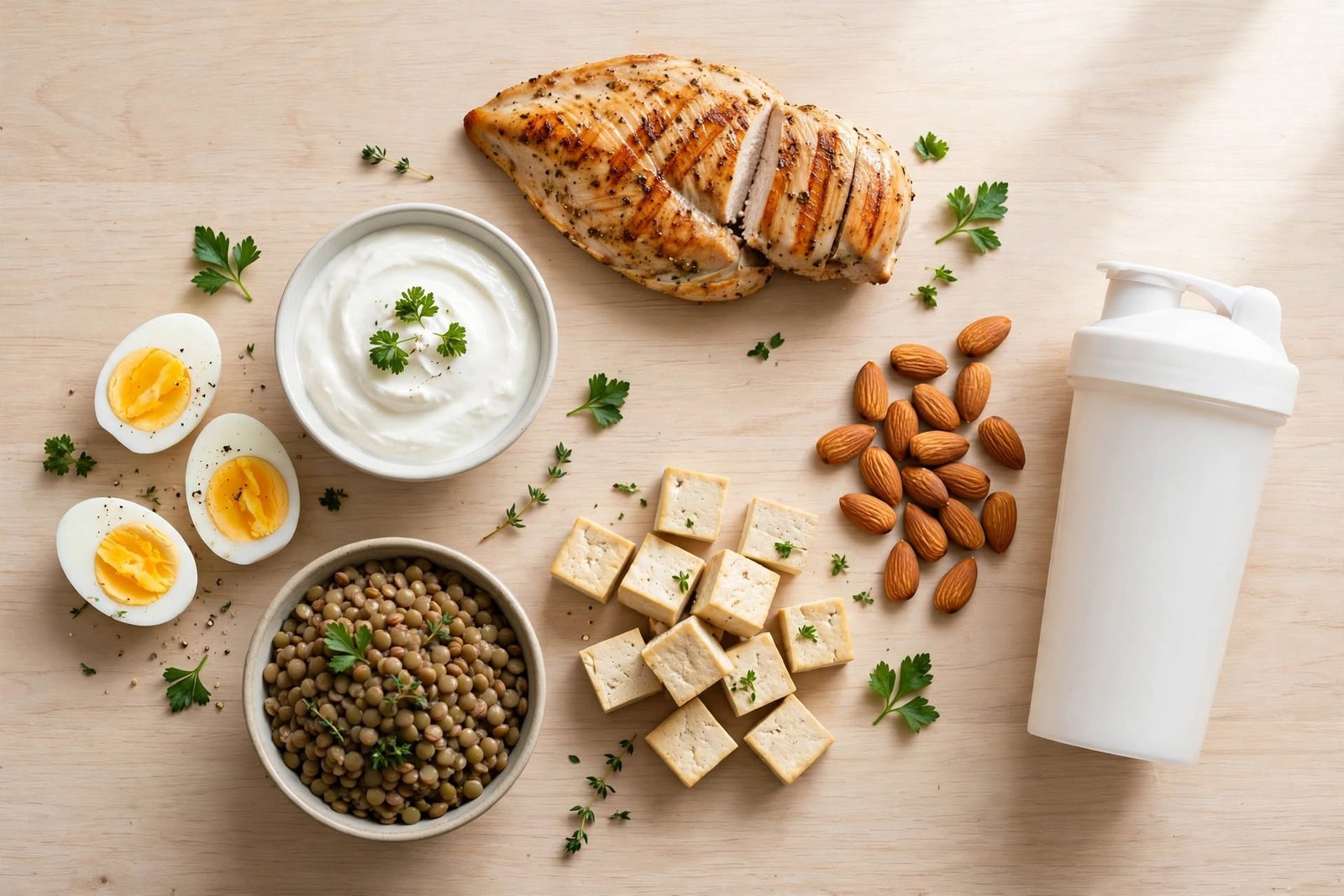
Most people can meet their protein needs from food. Good sources include:
- Animal sources: chicken, turkey, fish, lean beef, eggs, Greek yogurt, cottage cheese, milk
- Plant sources: lentils, beans, chickpeas, tofu, tempeh, edamame, seitan
- Snack options: nuts, seeds, protein-rich yogurt, cheese
Check nutrition labels for exact protein content, since it varies by brand and preparation.
When protein powder makes sense
Protein powder isn’t required, but it can help when:
- You struggle to reach your target with meals alone
- You need a quick option after training or during a busy day
- You follow a plant-based diet and want a convenient protein source
When choosing a powder:
- Look for third-party testing for purity and label accuracy, since supplements aren’t approved for effectiveness before sale.
- Check protein per serving, not just the scoop size.
- Watch the extras, such as added sugar or long ingredient lists.
- Choose a type that suits your diet and digestion, such as whey, casein, or plant blends.
Our guide to protein powders for muscle growth and recovery covers popular options, and you can browse Fittnexa’s protein powders category.
Is Too Much Protein Harmful?
For healthy adults, intakes around twice the RDA are generally considered safe, and the ISSN’s ranges reflect intakes used in research with exercising people. Still:
- People with kidney disease or reduced kidney function should not increase protein without medical advice. Their protein needs are often managed carefully.
- Very high protein intake can crowd out other foods, including fiber-rich carbohydrates, fruits, and vegetables.
- Protein still has calories. If you’re eating far more protein than you need on top of your usual diet, total calories can rise.
- Hydration matters. Drink enough water, especially if you increase protein and train hard.
If you have a medical condition, are pregnant or breastfeeding, or take medications, talk with your doctor or a registered dietitian before making major changes to your diet.
Common Mistakes to Avoid
- Treating the RDA as the target for muscle building. It’s a minimum, not an optimal amount for people who lift.
- Going far beyond what you need. Research suggests muscle gains level off around 1.6 g/kg.
- Eating most of your protein at dinner. Spread it through the day.
- Relying on powder instead of food. Shakes are a convenience, not a requirement.
- Ignoring training. Protein supports muscle growth only alongside resistance exercise.
- Forgetting total calories. Building muscle also requires enough overall energy.
Frequently Asked Questions
Is 1 gram of protein per pound of body weight necessary?
No. One gram per pound equals about 2.2 g/kg, which is above the level where muscle gains plateaued in the Morton meta-analysis. It’s not harmful for most healthy people, but around 0.7 g per pound is a well-supported target for building muscle.
How much protein can the body absorb at once?
Your body digests and absorbs nearly all the protein you eat. The question is how much a single meal stimulates muscle building. The ISSN suggests about 20–40 g per meal, spread every 3–4 hours, as a practical approach.
Do women need less protein than men?
Protein needs are based on body weight and activity, not sex. A woman and a man of the same weight and training level need similar amounts per kilogram.
Can I build muscle on a plant-based diet?
Yes. Combine a variety of plant proteins across the day, such as legumes, soy, grains, nuts, and seeds, and aim for the higher end of your target range, since some plant proteins contain lower amounts of certain amino acids.
Should I drink a protein shake right after a workout?
It’s a convenient option, but not essential. Having protein in the meals before and after training, and reaching your daily total, matters more than immediate timing.
Do I need more protein when losing weight?
Often yes. When eating fewer calories, a higher protein intake combined with strength training helps preserve muscle. The ISSN notes that intakes above 2.0 g/kg may help resistance-trained people during calorie deficits.
Conclusion
The RDA of 0.8 g/kg is a minimum, not an ideal for people who train. If you strength train, around 1.4–2.0 g/kg per day is well supported, and research suggests muscle gains level off near 1.6 g/kg for most people. Spread protein across three or four meals, aim for about 20–40 g per meal, and get most of it from whole foods, using powders for convenience if needed.
If you have kidney disease or another medical condition, or you’re pregnant, work with a healthcare professional to set the right target for you.
Sources
- Harvard Health Publishing. How much protein do you need every day?
- Jäger R et al. International Society of Sports Nutrition Position Stand: protein and exercise. J Int Soc Sports Nutr, 2017.
- Morton RW et al. A systematic review, meta-analysis and meta-regression of the effect of protein supplementation on resistance training-induced gains in muscle mass and strength in healthy adults. Br J Sports Med, 2018.
- MDLinx. How much protein do I really need?
Health information disclaimer: This article is for general educational purposes and is not medical or dietary advice. It has not been reviewed by a registered dietitian or physician. Individual protein needs vary. Consult a qualified healthcare professional if you have a medical condition, are pregnant or breastfeeding, or are considering major dietary changes.