Affiliate disclosure: Fittnexa participates in the Amazon Services LLC Associates Program. If you buy through links on this page, we may earn a commission at no extra cost to you. This is a research-based buying guide, not a hands-on review. We have not personally tested the machines mentioned.
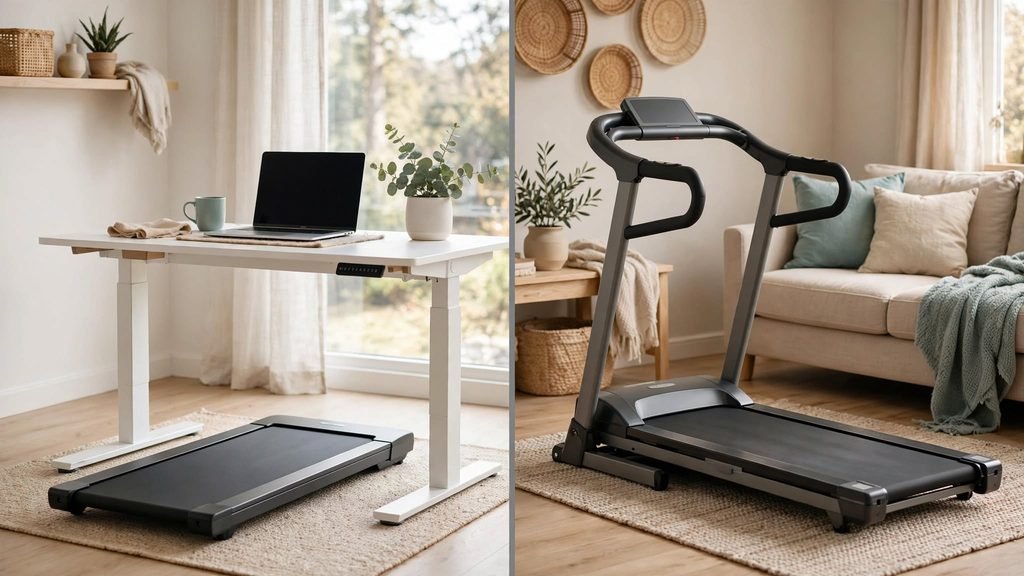
If you want to walk more at home this winter, you have probably narrowed it down to two options: a slim walking pad that slides under the couch, or a full treadmill with handrails, incline, and running speeds. Both put a moving belt under your feet. They suit very different people, though, and choosing the wrong one is the main reason home cardio equipment ends up gathering dust.
This guide covers what separates the two machines, what the research says about walking while you work, the safety points most comparisons skip, and a simple framework for deciding which one fits your goals, your space, and your budget.
The Quick Answer
Choose a walking pad if your main goal is to add steps during the workday, you have limited space, and you don’t plan to run.
Choose a treadmill if you want to jog or run, train with steep incline, need handrails for balance, or plan to do dedicated, structured workouts most days.
Consider a 2-in-1 hybrid (a walking pad with a fold-up handle and modest incline) if you mostly walk but want some extra intensity and stability without a full-size machine.
Walking Pad vs Treadmill at a Glance
| Feature | Walking Pad | Full Treadmill |
|---|---|---|
| Main use | Walking, often while working | Walking, jogging, running, incline training |
| Typical top speed | Usually walking pace (about 3.5–4 mph on many models); hybrids go higher | Running speeds |
| Incline | None to moderate on newer models | Usually available, often motorized |
| Handrails / console | Often none, or a fold-down handle | Full handrails and console |
| Footprint | Low profile, slides under furniture | Large; folding models still need floor space |
| Upfront cost | Lower | Higher |
| Best for | Desk walkers, small apartments, step goals | Runners, serious cardio, balance support |
What a Walking Pad Actually Is
A walking pad is essentially a treadmill without the uprights, handrails, or console. You’re buying a walking belt and a motor, without the rest of the machine. Most are controlled with a remote or an app and are designed to sit flat in front of a standing desk or to be stored away when not in use. garagegymreviews
The category has changed. Early walking pads were flat, slow, and rail-free. Many current listings now advertise handles, incline, and higher speeds. A look at the walking pads currently listed in Fittnexa’s walking pad category shows models advertising a 0.6–3.8 mph speed range with a 300 lb capacity, others with 6%, 8%, 10% or 12% incline, and “2-in-1” models with a safety handle that are marketed for walking or running. These are manufacturer claims, not test results. Still, the old “walking pads can’t do incline” rule no longer applies across the board. fittnexa
That shift matters for buyers. The real choice today is less “pad vs treadmill” and more where on the spectrum you need to be: flat pad, hybrid, or full treadmill.
What a Full Treadmill Gives You
A traditional treadmill has a motorized belt plus a handrail for balance support. It is usually more powerful than a walking pad and can be raised to an incline to simulate walking uphill. In practice, that means: healthline
- Running capability. Higher top speeds and longer decks give room for a running stride.
- Real incline training. Steep, motorized incline lets you raise intensity without running, which helps if running bothers your joints.
- Stability. Full side rails and a console help beginners, older adults, and anyone with balance concerns.
- Room to grow. If you might want to train for a 5K later, a treadmill avoids buying twice.
The trade-off is size, weight, and price. Even folding treadmills take up real floor space, and they are heavy to move.
The Question Most Comparisons Skip: What Will You Actually Do on It?
Most articles compare specs. The better starting point is your goal, because the evidence suggests that for many people a basic walking pad is enough.
If your goal is more daily steps
You may need fewer steps than you think. A large meta-analysis of 15 international cohorts in The Lancet Public Health found that mortality risk kept dropping as daily steps increased until about 6,000–8,000 steps per day for adults aged 60 and older, and until about 8,000–10,000 steps for adults under 60 (Paluch et al., 2022). This was an observational study, so it shows an association, not proof that steps alone caused the difference. nih
For a step goal, a walking pad running at an easy pace for an hour or two of desk time can close much of the gap. We cover the research in more depth in Do You Really Need 10,000 Steps a Day?
If your goal is to meet cardio guidelines
U.S. guidelines call for at least 150 minutes a week of moderate-intensity activity, and a brisk walk counts as moderate intensity. Brisk walking is commonly defined as 2.5 mph or faster, which is within the range of most walking pads. colostatecspinet
The catch: brisk walking is hard to keep up while typing. If you want structured cardio sessions, look for a pad with a higher top speed and some incline, or move up to a treadmill.
If you want to run or do steep incline workouts
Get a treadmill. Walking pads are generally built for walking and light jogging and lack the speed, deck length, and stability for regular running. Popular workouts like 30-minute walks at 12% incline also need incline that many flat pads simply don’t offer.
Walking While You Work: What the Research Says
The walking-desk setup is the main reason people buy walking pads, so it is worth knowing the trade-offs.
- Typing slows down. A meta-analysis of cycle and treadmill desks found that both reduced typing speed, with a larger effect for treadmill desks. The authors concluded the drop in performance was most likely not caused by a decline in cognitive function (Work, 2020). sagepubsagepub
- Fine motor tasks suffer most. A systematic review in Occupational and Environmental Medicine found that treadmill workstations reduced performance on typing, mouse pointing, and combined keyboard/mouse tasks compared with cycling and standing workstations, but also increased arousal and reduced boredom compared with standing (review summary). ulaval
What this means in practice:
- Walk during calls, video meetings you mostly listen to, reading, and email triage.
- Slow down or stop for detailed writing, design work, or spreadsheets.
- Start at a slow pace and short sessions, then build up over a few weeks.
- Raise your desk so your elbows stay at roughly 90 degrees while walking.
Space, Noise, and Your Home
Measure before you buy. As a rough guide, one manufacturer lists walking pads as needing about 20–25 inches wide, 50–60 inches long, and 5–8 inches high when in use. Check the actual dimensions of any model you’re considering, and leave clearance behind the belt. merachfit
Other practical checks:
- Storage. Will it actually fit under your bed or couch? Measure the gap, not just the room.
- Floors and neighbors. An equipment mat can protect flooring and reduce vibration. In upstairs apartments, footfall noise travels more than motor noise.
- Power. Plug directly into a wall outlet and follow the manual’s guidance on extension cords and surge protectors.
- Cords. Keep power cords out of walkways.
Safety: Handrails, Safety Keys, Kids, and Pets
This is the section most comparison articles leave out, and it’s important. According to the U.S. Consumer Product Safety Commission, an estimated 22,500 treadmill-related injuries were treated in U.S. emergency rooms in 2019, including about 2,000 involving children under 8. Treadmills cause the most at-home injuries related to exercise equipment (NBC News). NBC Newsinquirer
The CPSC recommends following manufacturer instructions, removing safety keys, and supervising children around the machines. Specific to walking pads: NBC News
- No rail means no catch point. If you have balance issues, dizziness, or are new to treadmill walking, a model with a handle or a full treadmill is the safer choice.
- Use the safety key or auto-stop if your model has one. Many remote-controlled pads have different stop mechanisms, so learn yours before walking at speed.
- Store it unplugged and out of reach of children, especially since pads sit at floor level.
- Keep pets out of the room while the belt is running.
- Don’t look down at your phone while stepping on or off.
If you have a heart condition, joint problems, are pregnant, or have been inactive for a long time, check with your doctor before starting a new walking routine.
The Specs That Actually Matter
| Spec | What to look for | Why it matters |
|---|---|---|
| Top speed | Walking pad: at least brisk-walk range. Treadmill: running speeds if you’ll run | Determines whether you can reach moderate or vigorous intensity |
| Incline | Optional for desk walking; important for hill or low-impact intensity | Lets you work harder without running |
| Weight capacity | Comfortably above your body weight | Affects stability and motor strain |
| Belt length and width | Longer for faster walking and any jogging | Short belts limit stride length |
| Handle or rails | Yes if balance is a concern | Fall prevention |
| Stop mechanism | Safety key, auto-stop, or easy remote stop | Rapid stopping if you stumble |
| Warranty | Separate motor and frame coverage | Signals expected lifespan |
A note on motor horsepower: manufacturers measure horsepower differently (“peak” vs “continuous”), so headline HP numbers aren’t always comparable across brands. Treat them as one input, not the deciding factor.
Cost: Upfront and Long Term
Walking pads are the cheaper entry point. At the time of writing, most models in Fittnexa’s walking pad category were listed under $200 after discounts, while a full treadmill is a larger investment. One health-system guide notes that budget treadmills are generally available for under $1,000, and premium connected models cost far more. Prices change often, so check current listings. allseturgentcare
The better question is cost per use. A $120 walking pad you use for 90 minutes every workday is better value than a $1,500 treadmill that becomes a clothes rack.
Decision Guide
A walking pad is likely the right fit if you:
- Work from home at a standing desk
- Mainly want more daily steps
- Live in a small apartment and need to store equipment out of sight
- Don’t plan to run
A full treadmill is likely the right fit if you:
- Want to jog, run, or train for a race
- Want steep incline workouts
- Need handrails for balance or confidence
- Plan to do dedicated 30–60 minute sessions most days
A hybrid walking pad with a handle is worth considering if you:
- Mostly walk but want occasional brisk or incline sessions
- Want some extra stability without a full-size machine
- Have limited space but expect your fitness to progress
If you’ve decided on a full treadmill, see our guide to the best treadmills for home workouts in 2026, or browse current walking pads and treadmills.
Common Mistakes to Avoid
- Buying a pad to run on. If running is part of the plan, a walking pad will frustrate you.
- Ignoring the stop mechanism. Know how to stop the belt instantly before you walk at speed.
- Walking too fast at your desk. Productivity drops and you’re more likely to trip. Slow down for detailed work.
- Skipping the measurements. Check both the in-use footprint and storage clearance.
- Expecting a pad to replace everything. Guidelines also recommend muscle-strengthening work at least two days a week, so pair walking with some strength training.
Frequently Asked Questions
Is a walking pad as good as a treadmill for weight loss?
Weight loss depends mostly on your overall energy balance and how consistently you move, not the machine. A walking pad you use daily can contribute more than a treadmill you rarely use. A treadmill offers more ways to raise intensity, such as running and steep incline.
Can you run on a walking pad?
Most standard walking pads are designed for walking and light jogging only. Some 2-in-1 models advertise running speeds with a fold-up handle, but their decks are usually shorter than full treadmills. Check the manufacturer’s stated use, belt length, and top speed.
How many hours a day can I use a walking pad?
There is no single rule. Start with short sessions, such as 20–30 minutes at a slow pace, and build gradually. Check your model’s manual, since some manufacturers recommend rest periods between long sessions.
Do walking pads need maintenance?
Yes. Most need periodic belt alignment and lubrication according to the manufacturer’s schedule. Keeping the area clean and dust-free also helps the motor last longer.
Can I count walking pad steps on my fitness tracker?
Wrist-based trackers can undercount steps when your hands rest on a keyboard, because they rely partly on arm movement. A tracker clipped to your waist or the pad’s own step count may be more accurate. See our guide to fitness trackers for options.
Conclusion
The best choice depends on what you’ll actually do. If you want to turn desk hours into walking minutes and you’re short on space, a walking pad is a practical, affordable tool, and the research suggests that adding steps toward the 6,000–10,000 range is meaningful. If you want to run, train on steep inclines, or need handrails, a full treadmill is the better long-term buy. If you’re in between, a hybrid pad with a handle and incline is a sensible middle ground.
Whichever you choose, put safety first: learn how to stop the belt, keep kids and pets away, and start slowly.
Sources
- Paluch AE et al. Daily steps and all-cause mortality: a meta-analysis of 15 international cohorts. Lancet Public Health, 2022.
- The effects of cycle and treadmill desks on work performance and cognitive function in sedentary workers: a review and meta-analysis. Work, 2020.
- Health and productivity at work: which active workstation for which benefits: a systematic review. Occupational and Environmental Medicine, 2019.
- U.S. Consumer Product Safety Commission data as reported by NBC News.
- Physical Activity Guidelines summary, Center for Science in the Public Interest.
Health information disclaimer: This article is for general educational purposes and is not medical advice. Consult a qualified healthcare professional before starting a new exercise program, especially if you have a medical condition, are pregnant, or have concerns about balance or joint health.