Smart scales promise far more than your weight. Step on one and your app may show body fat percentage, muscle mass, water, bone mass, visceral fat, even a “metabolic age.” Some listings advertise 13, 50, or more metrics.
So how much of that is real? This guide explains how smart scales estimate body composition, what independent studies found when they compared smart scales with lab methods, why your body fat reading can jump overnight, and how to get the most useful information from the scale you own or plan to buy.
The Short Answer
- Weight: generally accurate. In a study comparing three smart scales with a DEXA lab scan, all three measured weight within about a kilogram (around 2 lb).
- Body fat: an estimate, not a measurement. Studies show smart scales can be off by several percentage points for an individual, and some tend to underestimate body fat.
- Average accuracy can hide large individual errors. A scale can look accurate across a group of people while being far off for you personally.
- The trend is more useful than any single number, especially if you measure under the same conditions each time.
- Safety: Manufacturers commonly warn against using the body-composition feature if you have a pacemaker or other implanted electronic device, or are pregnant.
How Smart Scales Estimate Body Fat
Most smart scales measure weight with standard load sensors, the same way a regular scale does. Body composition is a different story.
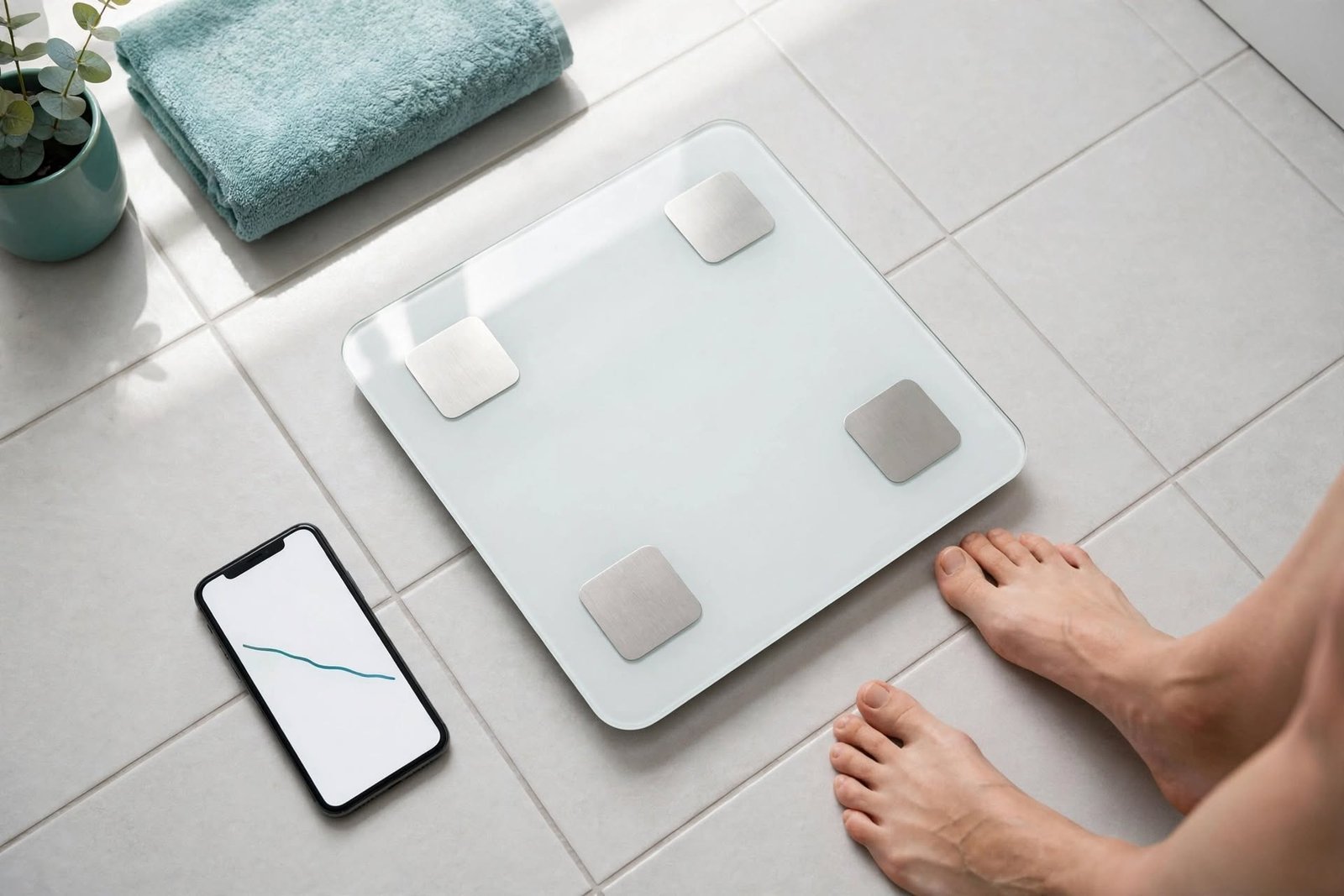
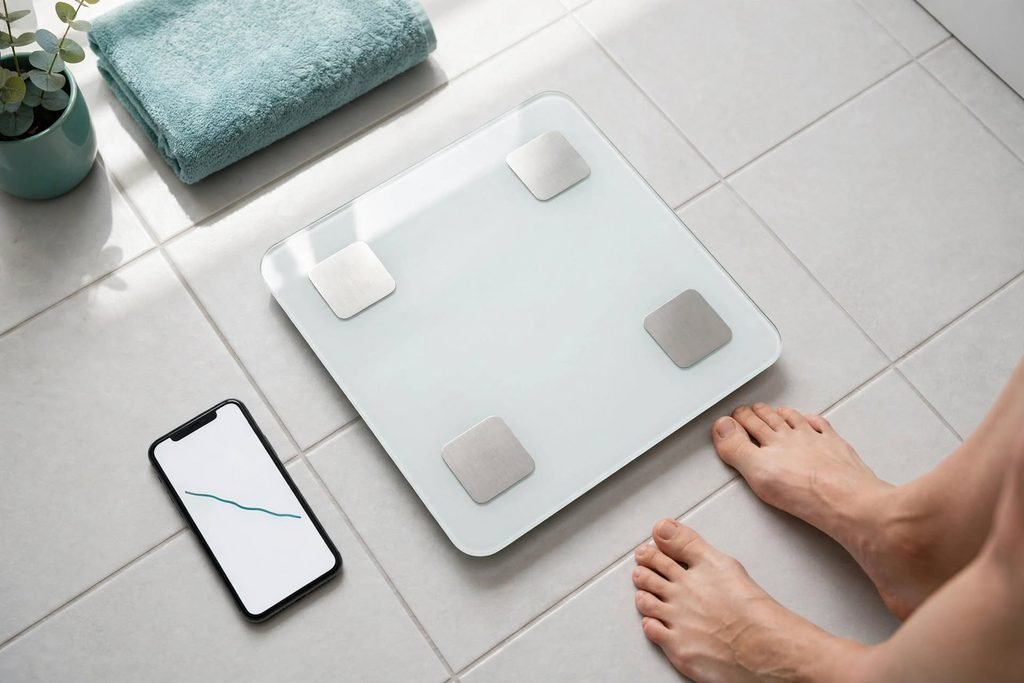
To estimate body fat, the scale uses bioelectrical impedance analysis (BIA). It sends a very small electrical current through your body via the metal pads under your feet (and, on some models, handles you hold). Water-rich tissue like muscle conducts electricity more easily than fat. The scale measures the resistance, then plugs it into a formula along with the height, age, and sex you entered in the app.
Two important points:
- The scale doesn’t “see” fat. It measures electrical resistance and estimates body composition from a formula. The formula was developed on reference populations, so it fits some people better than others.
- Foot-only scales mostly measure your lower body. On a standard scale, the current travels up one leg and down the other. Scales with handles (often called 8-electrode or hand-and-foot scales) send current through the upper body too.
What the Research Says
Weight is reliable; body fat less so
A 2021 study in JMIR mHealth and uHealth compared three commercially available smart scales with DEXA, a lab X-ray method widely used as a reference standard (Frija-Masson et al., 2021). Roughly 50 patients were tested on each scale:
- All three scales measured weight closely, with a median difference of less than 1 kg from DEXA.
- All three underestimated body fat. Median fat mass errors ranged from about 2.2 kg to 4.4 kg, depending on the scale.
- The authors concluded that smart scales are not accurate for body composition and shouldn’t replace DEXA in patient care.
Good on average, unreliable for individuals
A study published in Obesity Facts compared several consumer BIA devices with MRI and DEXA in 106 adults (Bosy-Westphal et al.):
- Some devices showed small average errors, under 1.5 percentage points of body fat.
- But for individuals, the range of error was wide. For foot-to-foot devices, a person’s reading could be off by roughly 14 points too low to 9 points too high.
- A device using hands and feet had the narrowest range of error.
- The authors concluded that hand-and-foot devices should be preferred for individual use, while foot-only devices are better suited to group estimates in research.
An older study in overweight and obese men reached a similar conclusion: some BIA methods showed little average bias, but their usefulness for assessing individuals was limited (Brinkworth et al., 2006).
What this means in practice
Average accuracy is not the same as personal accuracy. Imagine a scale that’s perfectly accurate on average across 100 people, but for any one person can be off by 8 points. If it tells you 25% body fat, your true value could plausibly be anywhere from the high teens to the low 30s.
Note: These studies tested specific devices. Results vary by brand, model, and the person being measured. A scale having more electrodes doesn’t guarantee accuracy; it just changes how the current travels through your body.
Why Your Body Fat Reading Changes Day to Day
Because BIA depends on how water is distributed in your body, everyday factors can shift your reading even though your actual body fat hasn’t changed overnight:
- Hydration: Drinking a lot of water, or being dehydrated, changes your reading.
- Recent exercise: Sweating and blood flow changes after a workout can affect results.
- Meals and drinks: Weighing right after eating or drinking adds weight and changes fluid balance.
- Time of day: Fluid shifts during the day, so evening readings often differ from morning ones.
- Skin contact: Dry, calloused, or wet feet, or socks, interfere with the electrical contact.
- Alcohol, caffeine, and illness can all affect fluid balance.
This is why a 1–2 point change in body fat from one day to the next is usually noise, not real change.
How to Get the Most Consistent Readings
You can’t make a home scale as accurate as a lab scan, but you can make its readings more consistent:
- Weigh at the same time every day, ideally in the morning after using the bathroom and before eating, drinking, or exercising.
- Step on with clean, bare, dry feet, centered on the electrodes.
- Place the scale on a hard, flat floor in the same spot every time. Carpet can affect weight readings.
- Keep your profile accurate. Update your height and age. If your app has an “athlete mode,” use it only if it truly fits you, because it changes the formula.
- Look at weekly or monthly averages, not single days. Most apps show trend lines.
- Ignore small daily swings in body fat, and look for steady changes over several weeks instead.
Which Metrics Can You Trust?
| Metric | How it’s obtained | How much to trust it |
|---|---|---|
| Weight | Measured directly by load sensors | High, if the scale is on a hard, level floor |
| BMI | Calculated from weight and the height you entered | As accurate as your inputs, but BMI itself has known limits |
| Body fat % | Estimated by BIA and a formula | Ballpark; better for trends than exact values |
| Muscle or lean mass | Estimated from the same BIA reading | Ballpark; shares the same limitations |
| Body water % | Estimated from impedance | Sensitive to hydration; fluctuates daily |
| Visceral fat, bone mass, protein, “metabolic age” | Derived from the formula and your profile data | Treat as rough estimates; independent validation for these metrics is limited |
Tip: A tape measure is a useful partner to a smart scale. Body fat scales can’t tell you where you store fat, and measuring your waist adds information about fat around your midsection (Healthline).
Who Should Not Use the Body Fat Feature
Smart scales send a small electrical current through your body. Manufacturers commonly include these warnings:
- People with a pacemaker, implanted defibrillator, or other implanted electronic medical device should not use body-composition features. Philips and Omron manuals list this, and Withings advises against using its Body Smart scale with a pacemaker (Withings).
- Pregnant people: Some manuals say not to use the body fat feature during pregnancy, and others recommend turning off impedance measurements as a precaution.
Many scales let you turn off the body-composition feature in the app and use the device as a weight-only scale. Always check the manual for your specific model.
A Note on Your Wellbeing
Daily weigh-ins work well for some people and feel stressful for others. If checking the scale often makes you anxious or affects how you feel about yourself, it’s completely fine to weigh less often, hide body-fat readings in the app, or focus on other markers of progress, such as strength, energy, sleep, or how your clothes fit. If your relationship with food or weight feels difficult, consider talking to a healthcare professional.
Choosing a Smart Scale: What Actually Matters
If you’re shopping for a smart scale, focus on features that make a real difference:
- Reliable weight readings and good reviews of consistency. Weight is the metric you can trust most, so make sure it’s repeatable.
- Hand-and-foot (8-electrode) design if body fat estimates matter to you. Research on specific devices suggests this layout can narrow individual error, but it doesn’t guarantee accuracy.
- App quality and data export. Look for clear trend charts and compatibility with Apple Health, Google Health Connect, or your fitness tracker’s app.
- Privacy. Body data is personal. Check what the app collects and whether you can use the scale without an account.
- Multi-user profiles if your household will share it.
- Weight capacity that comfortably exceeds your body weight.
- The ability to turn off BIA if anyone in your household has an implanted device or is pregnant.
Be skeptical of claims like “50+ metrics” or “clinically accurate body composition.” More metrics usually means more values derived from the same single impedance reading, not more measurements.
You can browse current models in Fittnexa’s smart scales category. If you also track activity, our guide to fitness trackers covers devices that sync with many smart scale apps.
Frequently Asked Questions
Which is the most accurate way to measure body fat?
Lab methods such as DEXA, hydrostatic (underwater) weighing, and air displacement are much more accurate than home smart scales. They’re also more expensive and less convenient. For most people, a home scale used consistently is fine for tracking general trends.
Why does my smart scale give a different body fat reading than my gym’s machine?
Different devices use different electrode layouts, electrical frequencies, and formulas. Readings between brands often don’t match, so compare readings only from the same device under similar conditions.
Why did my body fat jump after a workout?
Exercise changes your hydration and blood flow, which affects the electrical reading. Measure at a consistent time, ideally in the morning before exercise, to reduce this effect.
Are expensive smart scales more accurate?
Not necessarily. Price often reflects design, app features, and extra metrics rather than proven accuracy. Hand-and-foot designs may have an advantage for body fat estimates, but look for independent testing rather than marketing claims.
Can a smart scale tell me if I’m losing fat or muscle?
Only roughly. Fat and muscle estimates both come from the same impedance reading and formula. Over several weeks of consistent measurements, a clear trend can be informative, but it can’t precisely separate fat loss from muscle or water changes.
Is it safe to use a smart scale every day?
For most people, yes. The electrical current is very small. The main exceptions are people with implanted electronic medical devices and, according to some manufacturers, pregnant people, who should turn off body-composition features or follow their manual’s guidance.
Conclusion
Smart scales are accurate for what they actually measure: your weight. Body fat, muscle mass, and the other metrics are estimates from a formula, and research shows they can be off by several percentage points for an individual, even when average accuracy looks good.
Use a smart scale as a trend tracker, not a precise body-composition test. Weigh at the same time, under the same conditions, and focus on weekly averages. Pair it with a tape measure and other markers of progress. And if you have an implanted medical device or are pregnant, turn off the body-composition feature or follow the manufacturer’s guidance.
Sources
- Frija-Masson J et al. Accuracy of Smart Scales on Weight and Body Composition: Observational Study. JMIR mHealth and uHealth, 2021.
- Bosy-Westphal A et al. Accuracy of Bioelectrical Impedance Consumer Devices for Measurement of Body Composition in Comparison to Whole Body MRI and DXA. Obesity Facts.
- Brinkworth G et al. Comparison of three bioelectrical impedance methods with DXA in overweight and obese men. 2006.
- Withings: Body Smart safety FAQ; Philips: Body analysis scale user manual.
- Healthline: Body fat scale accuracy.
Health information disclaimer: This article is for general information only and is not medical advice. Smart scales are not diagnostic devices. Talk with a healthcare professional about body composition, weight changes, or any health concerns.